 |  |
Recurrent Dynamic Range Extension




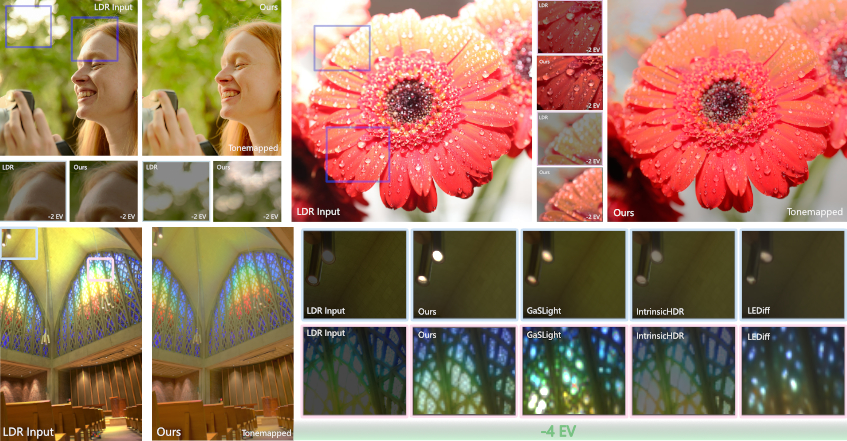
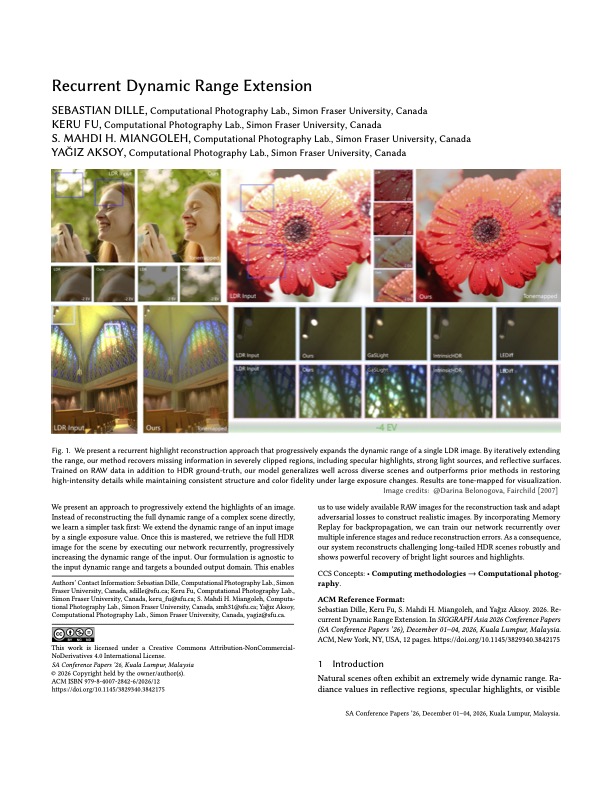
We present a recurrent highlight reconstruction approach that progressively expands the dynamic range of a single LDR image. Our method recovers missing information in severely clipped regions reliably, including specular highlights, strong light sources, and reflective surfaces.
Abstract
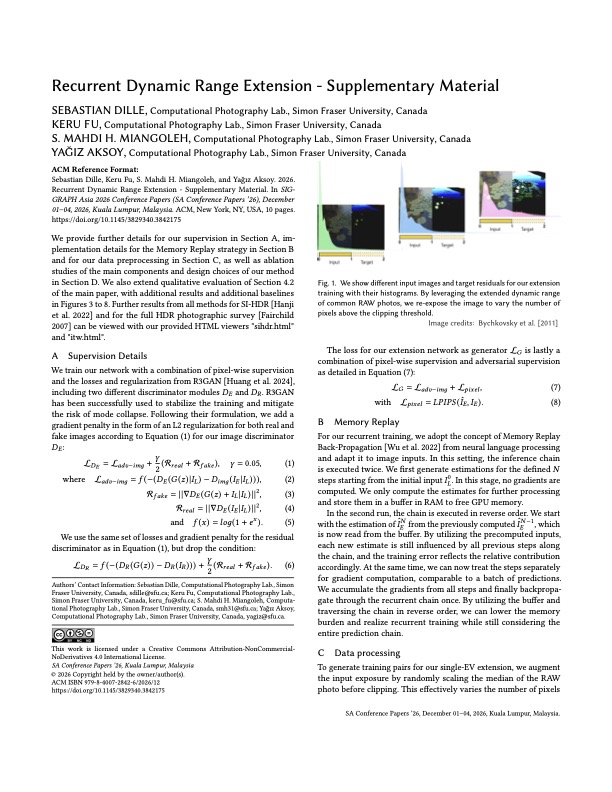
We present an approach to progressively extend the highlights of an image. Instead of reconstructing the full dynamic range of a complex scene directly, we learn a simpler task first: We extend the dynamic range of an input image by a single exposure value. Once this is mastered, we retrieve the full HDR image for the scene by executing our network recurrently, progressively increasing the dynamic range of the input. Our formulation is agnostic to the input dynamic range and targets a bounded output domain. This enables us to use widely available RAW images for the reconstruction task and adapt adversarial losses to construct realistic images. By incorporating Memory Replay for backpropagation, we can train our network recurrently over multiple inference stages and reduce reconstruction errors. As a consequence, our system reconstructs challenging long-tailed HDR scenes robustly and shows powerful recovery of bright light sources and highlights.
Paper
 |
 |
BibTeX
author={Sebastian Dille and Keru Fu and S. Mahdi H. Miangoleh and Ya\u{g}{\i}z Aksoy},
title={Recurrent Dynamic Range Extension},
booktitle={Proc. SIGGRAPH Asia},
year={2026},
}
Related Publications
|
ECCV, 2024
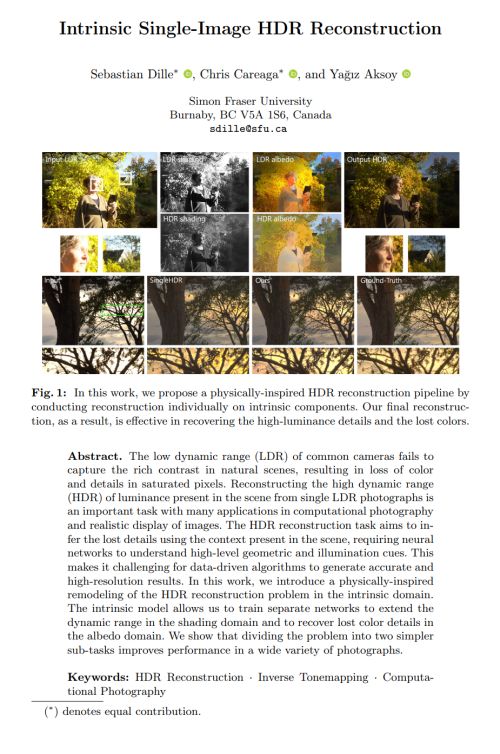
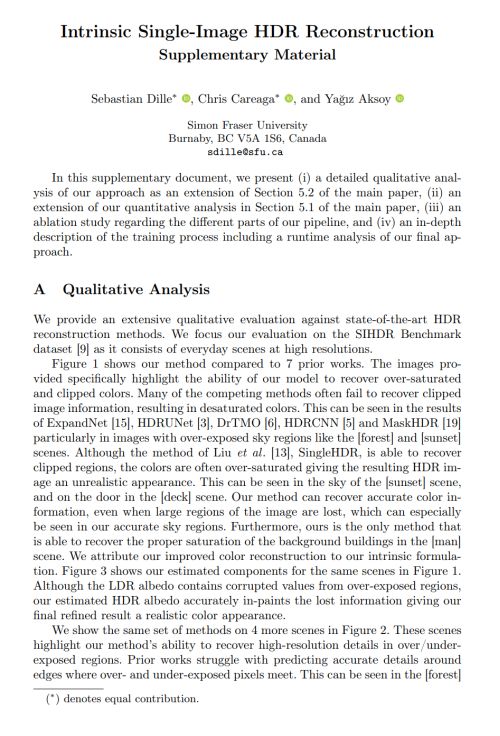
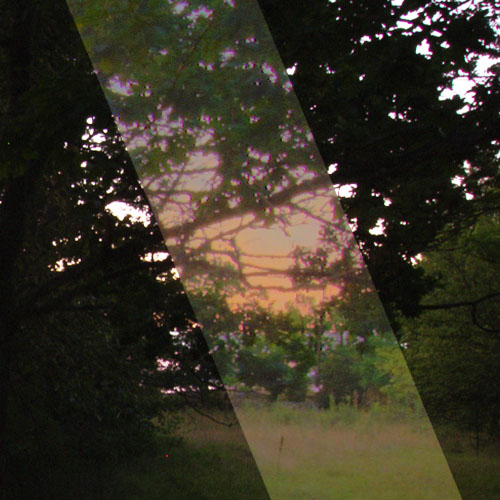
The low dynamic range (LDR) of common cameras fails to capture the rich contrast in natural scenes, resulting in loss of color and details in saturated pixels.
Reconstructing the high dynamic range (HDR) of luminance present in the scene from single LDR photographs is an important task with many applications in computational photography and realistic display of images.
The HDR reconstruction task aims to infer the lost details using the context present in the scene, requiring neural networks to understand high-level geometric and illumination cues.
This makes it challenging for data-driven algorithms to generate accurate and high-resolution results.
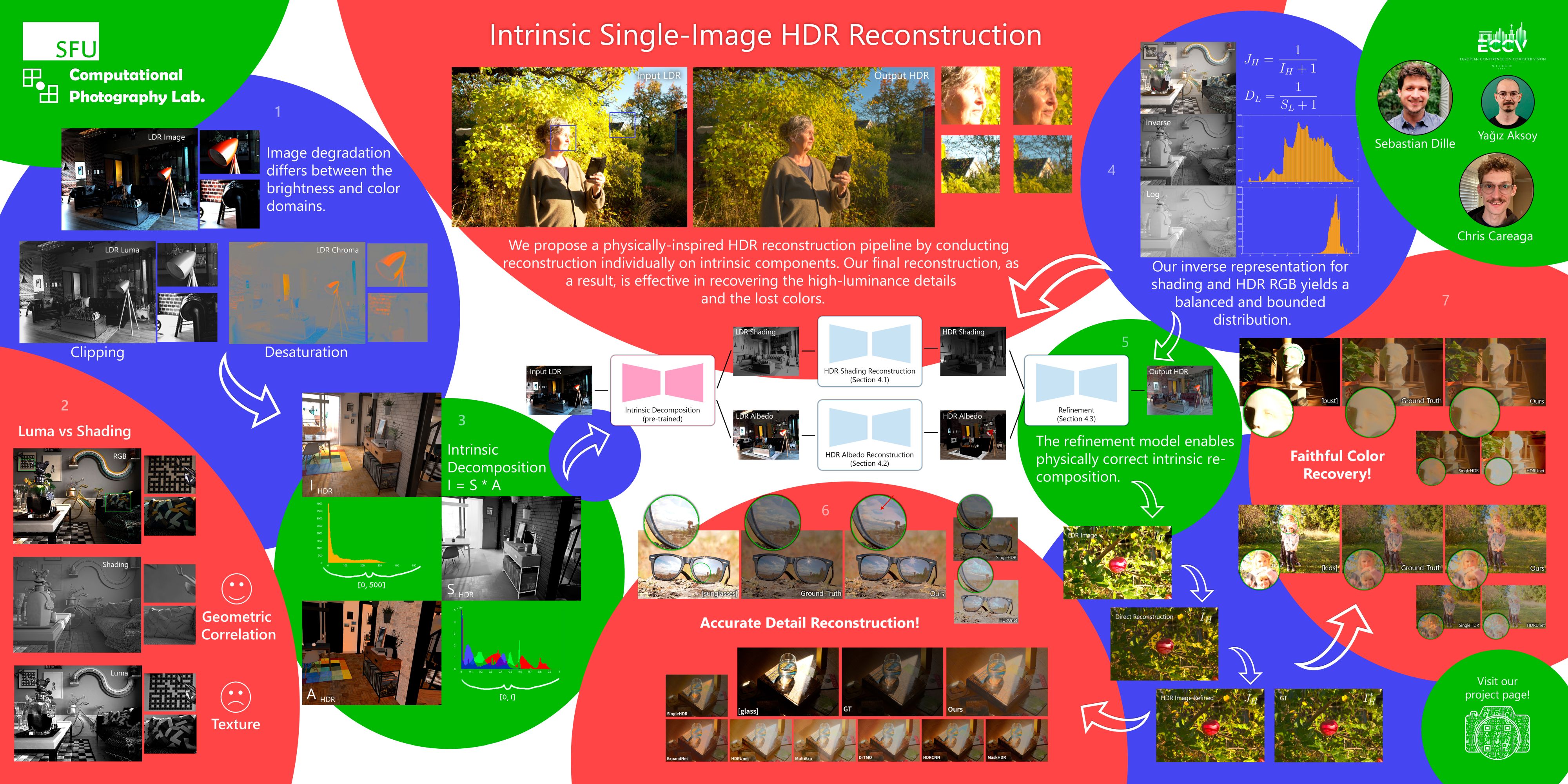
In this work, we introduce a physically-inspired remodeling of the HDR reconstruction problem in the intrinsic domain.
The intrinsic model allows us to train separate networks to extend the dynamic range in the shading domain and to recover lost color details in the albedo domain.
We show that dividing the problem into two simpler sub-tasks improves performance in a wide variety of photographs.
@INPROCEEDINGS{dilleIntrinsicHDR,
author={Sebastian Dille and Chris Careaga and Ya\u{g}{\i}z Aksoy}, title={Intrinsic Single-Image HDR Reconstruction}, booktitle={Proc. ECCV}, year={2024}, } |